A strange thing has happened here. Of all of the interesting social movements going on in Bolivia, Santa Cruz has not exactly been at the forefront of any of them. But last week, we experienced a bit of a peoples’ uprising here in our neighborhood. It started when micro bus drivers decided to try once again to raise the price of riding the micro (one of several attempts in the past few months) from 1.5bs to 2bs (about .20 to .28).
On Tuesday Chris and I went out to the bus stop and found one of our friends Julia waiting there as well. We watched as a bus approaching us turned around in the middle of the street and let everyone off. I just figured it was a mecanical problem with the micro, but since Julia has a TV and we don’t, she knew better. She had seen on the news that they were going to try to raise the price. So we waited a few minutes while everyone from further down the road came walking up to the final stop of the buses. We then saw a micro going down a different street and circling around further down the road. The tactic, we believed, was not to pick up a crowd of people all at once. We decided to try a different micro line and as we walked away, we met up with a 53 (the line we had been waiting for) on a side street. I tried flagging it down and the driver yelled “where are you going? To the center? It’s 2bs per person. If you want to pay that, get in, if not, let me go.” Chris and I both looked at Julia, who just scoffed and kept walking. “They’ll never win.” Julia told us as we walked away. “ Everyone knows a micro driver is still making money on us all.”
(I suppose I have failed you all for not having written about micros before, because, even on a normal day, it’s never a dull experience. There are seats for about 20 and during peak hours (6-8am and 6-8pm) it’s nothing to have 50 people sitting, standing, plastered to the windows and each other, just trying to get to work. The general rule is that mothers with babies, very pregnant women and old ladies are supposed to get seats, but there’s a bit of a reputation for young men (who are commuting to and from 12 hour work days in most cases) to not be so courteous. There is also a rule that kids who don’t pay the full fair shouldn’t occupy a seat if a full-fare payer is standing up..again, they tend to hide in the back and wait for someone to call them out. Anyway, some of my favorite stories come from micro riding experiences).
Some drivers own their own micros, while other rent them. Apparently you have to pay between $100-$300 US to get into an associacion of drivers and once you’re in, you pay dues. According to Julia, her friend owns a micro and the man who rents it even after rent and all the other costs, can still make between 200 and 400bs a day ($27-54 US). The upper end being about a month’s wage for a maid. There is plenty of justification for a micro driver earning so much. There are plenty of risks involved, penalties to be paid if you’re late, and LONG days (sometimes up to 14 hrs), but you can understand how people are refusing to pay more money. Chris and I find ourselves a bit in the middle. We could easily pay the higher fare. If Julia weren’t with us, it’s hard to say what we would’ve done. But for now, it makes the most sense to support our friends whose economy is already too tightly stretched.
miércoles, 23 de abril de 2008

martes, 4 de marzo de 2008
fun with pictures
without further adeu, a collage of photos.
 our new dog princesa, for a princess, she's not all that fotogenic, but she has plenty of other princess like qualities:)
 Luna in her favorite sleeping spot, on the other side of the window is where we sleep, so you can see how it's prime real estate for a protective dog
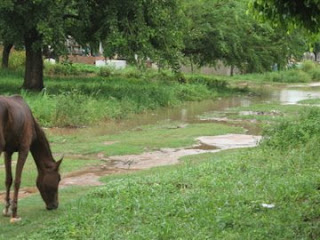 a little look at the rainy season, the road outside of our house
 our mango tree, some basil and LOTS of weeds
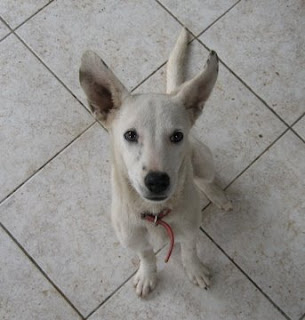 Luna, all grown up
 our new dog princesa, for a princess, she's not all that fotogenic, but she has plenty of other princess like qualities:)
 Luna in her favorite sleeping spot, on the other side of the window is where we sleep, so you can see how it's prime real estate for a protective dog
 a little look at the rainy season, the road outside of our house
 our mango tree, some basil and LOTS of weeds
 Luna, all grown up
salteñas


Just as I had the idea of sharing with you one of the sweetest things 20 cents can buy in Santa Cruz, I got an email from my sister and my niece who are looking for more pictures of our house and dogs, and less of food. So, in the interests of pleasing all parties, I will include a few photos here that are not part of today’s blog theme: a little thing folks here like to call salteñas.
Salteñas, I believe are something unique to Bolivia. They are a cute little meat pocket made with a beautiful color of dough, full of potatoes, peas, meat and broth. Each reigon has their own style of making them. Santa Cruz salteñas are especially juicy and full. MCC likes to initiate new volunteers by serving salteñas the first day you arrive. There is a serious trick to eating Santa Cruz salteñas without getting the juice all over you, which involves carefully biting off the tip and draining out as much juice as possible through the tiny hole. After we eat salteñas at MCC, you can sure tell a difference (as if you couldn’t already) between a native cruzeno pro and a novice by the little stains we sport for the rest of the day.
In Chris and I’s neighborhood, we have a woman who at just about 7:45 every morning passes by our house offering salteñas. Luckily, I believe hers are more of a style of Potosi (a city about 24 hrs. west of here); much dryer. There is a tiny bit of gravy you need to be careful with at the very bottom, but it’s quite manageable. They are smaller than the ones you buy in the center of town, but at 25 cents a piece, (the ones downtown are about 75 cents) they are more affordable as well…which means we find ourselves getting them about 3 or 4 mornings per week.
martes, 22 de enero de 2008
Housing

I went to see my friend Doña Beti (doña (pronounced don-ya) is the name that goes before every woman’s name to show respect) about making me a cake for my buddy’s birthday. (she is pictured here on the far right side).But here in Bolivia, just like in many fine countries in the world, conversation kind of wanders around what you came for, and you tend to go to it for awhile and then talk about other stuff, then come back (often at the gringos promptingJ). Anyway, in the midst of the meandering, it came up that Dona Beti is moving. Which is a sad thing, because she’s one of the crucial social hubs in the barrio and she keeps things moving, and even though she’s only moving about six blocks away, it will really change things. I asked her why and she said she’s been renting this place and has found another place to live “casero” (which means the shack or whatever is on the property is not suitable enough to actually charge rent, so you make an agreement with the owner to take care of the property, usually for one year at a time for no cost).
She then talked about looking into buying a lot here, and she said there are some in the next neighborhood over (which is less developed than ours and has more open spaces) for $3500. At first I thought she was talking about bolivianos (which would still be $500 or so), but she actually meant dollars. She said they would probably give it to her on credit. She said her friend bought one awhile back for $100. With the arrival of several thousands of people to Santa Cruz each year, housing prices have sky-rocketed. My friend whose grandparents live just off the first ring in the center of the city told me their house is worth $100,000. I’m sure her grandparents settled there when there was nothing but forest beyond the first ring and probably everything including the construction of the house cost less than $100. In the 1960s when MCC was setting up its office, everyone told them they were out in the middle of nowhere and that people would never be able to find it (just between the 1st and 2nd ring). Now, their property is right smack in the middle of it all (and with five buildings on it and a nice piece of yard in the middle, I’m sure it’s worth several hundred thousand dollars now)..
Of course this means good things for people like Loida’s grandparents and MCC and other visionary folks who were able to buy up early and could cash out now. But for Doña Beti, who has lived and worked in this neighborhood for the past twenty years, the dream of owning her own place is just slipping out of grasp. The really crazy thing for me to think about is that during the three years that Chris and I are here in Bolivia, I’ve calculated that all the money we have saved and smartly (with the advice of my brother-in-law/financial advisor) invested will make us about half of what it costs to buy one of those lots. We get paid just for being rich. My first reaction to that is the easiest “well, could we give her all we’re going to make on the interest.” Which would leave us still rich, having dona beti still paying a lifetime of payments on her place, a whole neighborhood in line for another one of our generous donations and a system that still makes rich richer and poor poorer. We have got to think of something better. Any ideas?
martes, 8 de enero de 2008
Reproductive Rights?

The photo is of Ana Maria, one of the mom’s in the nutrition group we work with. She is posed with her fifth child, the only girl. Ana Maria is always looking for money. Her kids walk around with mismatched flip-flops and snotty noses. Her husband works harvesting wood and comes home about twice a month and leaves her with about $6 USD until he comes back the next time. Sister Benedicta, one of the nuns who works at the chapel who sponsers the program, apparently would often bring up birth control in her visits to Maria when she had four children, proposing that perhaps four was enough. One of Ana Maria’s sons died last year of a flu that just wouldn’t go away. And before the sister could get her a date with a doctor to discuss some kind of birth control, Ana Maria was once again pregnant. This time sister benedicta was not going to let it happen again. She went and visited with Ana Maria in the hospital and talked with the nurses, who handed over some papers with a date to come back for an IUD.
But it still wasn’t quite so easy. The doctor had operated on a hernia that Ana Maria had aquired during her pregnancy, and according to Ana Maria, just tied her tubes while he was at it, so in her opinion, she didn’t need to get an IUD. Benedicta just assumed that she was lying because she was afraid of the IUD, so I went one day and visited her. “Oh, I’ve had one before,” she said, “it’s just that it gave me really bad cramps and I couldn’t go to my monthly check-ups because we lived out in the country. The doctor told me he tied my tubes, I don’t know why I’d need an IUD also.” The sister was not convinced. Her papers said come back in a month for the IUD, nothing else appeared in the care instructions. It is rumored that in order to do tube tying, the doctor must get the signature of the woman’s husband (which never happened). So, they took a trip to the doctor’s office to get the story. Apparently the doctor, upon hearing about Ana Maria’s life, took advantage of the fact that he was so close in the hernia surgery and just tied her all up at once. “And the papers, you ask”. Well, apparently the nurses filled them out upon talking with the Sister, unaware of what the doctor had already done.
I’m sure this story is not all that rare here, and in other places in the world. We tend to think about poverty and overpopulation being an issue of lack of access and bad information. But here, three blocks away from my sand filled street, there is a clinic that puts in IUDs for free. It seems though, there are problems in the administration, because I have heard horror stories of IUDs here, in one case a baby born with a T imprinted on his face (which I cannot confirm)! Anyway, I wonder what we should do when a mother is well informed of her options and still wants to continue having children. In the long run, I think the doctor did Ana Maria a favor. But in such a shady process of just using the power he had as a surgeon to decide the future of Ana Maria and her family, I’m not convinced it was the right thing. When it comes to a person’s will over their life, I don’t think it matters if it’s a doctor a nun or a northamerican volunteer with the best intentions, it isn’t our job to decide the fate of others.
sábado, 1 de diciembre de 2007
Thanksgiving


Chris and I had quite the adventure for Thanksgiving. We went to visit a few fellow MCCers in the area of Moro Moro, a small town about 6 hours west (9 in bus) of the city. We left on Tuesday and returned on Friday. After arriving, we took a tour of the town (which took about 20 minutes☺) and on Wed, in the pouring rain, we got to see some water projects of a community called “the knife.” The project involves capping springs and then digging pipe lines to people’s houses. This particular project is administered by Krista and Brian, a couple living in the town of moro moro. On Thursday however, we woke up to a sunny day and were able to go out to “La Ahbra” (the only definition we found was a little valley) where another friend, Nate Harder lives. There we chopped wood (well, some of us….I chopped green beans☺) and began a fire in Nate’s clay stove. It took awhile since everything was wet, but the feast was definitely worth waiting for…complete with turkey, filling, mashed potatoes, sweet potatoes and green bean casserole (and of course, pumpkin pie and coffee).
One funny thing that happened is that we forgot the flour at Krista and Brian’s house (a short 20 km away) and since Nate had no flour, he got out the ole’ hand grinder and began grinding some wheat he had traded for some fruit he was growing. After about 3 passes through the grinder and then through the sifter, we had the half cup necessary for the gravy. It was all very yummy.
While we were eating, a friend of Nate’s shows up and asks if Nate can do him a favor. Nate does his best to get it out of him what it is he’ll be doing before he commits to it, but he can’t. So he says yes. He asks him to help him castrate his pig and asks if he knows how. Nate says he just knows how to hold down the feet, and Don Juan says that’ll do. As they walk out the door, Chris gets invited along, and Cesar (our director at MCC) and his two kids tag along and I send Brian with the camera. Well, as it has been retold to me (several times), Chris and Nate hold the feet while Don Juan works his magic. Cesar tries taking pictures, but is distracted by the angry, untied mother charging Nate and Chris, so he jumps into the pen and begins hitting her with a stick (still attempting to take pictures with the other hand, but not successfully). After the job is done, Don Juan covers the wound in ash (apparently a disinfectant), and then proceeds to shake everyones hand. Cesar’s 6 year old daughter was the most reluctant, but everyone managed to hold politeness over hygene. Even though I just witnessed the events by hearing the squeals of mother and child from afar, it will surely be a Thanksgiving for telling the grandchildren (or at least the nieces).
martes, 27 de noviembre de 2007
party frenzy


My friend Wendy, when I told her I began a blog, said, “if in six months you are still posting on it, I will then shake your hand.” Well, the month of December is just around the corner and that will complete my six months (as I started in July). But I’m not sure I quite complete the criteria of being a faithful blogger. Since my October trip with Witness For Peace throughout Bolivia, Chris and I have been kept fairly occupied, In the last three weeks we’ve had three graduations, two birthday parties, a painting exposition and a trip out to the countryside for a good old fashioned Thanksgiving. All of which provide for prime blogging material (not to mention the trip with Witness for Peace). So, I guess I’ll start with birthdays and graduations and try to combine them all together. First of all, in November there is no Thanksgiving here (unless you’re a gringo and willing to pay the $20 for a frozen turkey), but there are graduations. Since we’re on the southern hemisphere, we’re heading into summer right now, and schools work within that same system; kids go to school from mid February through mid November. The interesting thing is that graduations are the jump-start to the end of the year economic boom (much more tolerable than black Friday if you ask me), and it continues right up through Carnival (a marti-gras type festival) this year set for the 5th-8th of February.
Graduations seem to me to be a bigger deal here than I remember them being in the U.S. What keyed us into that realization was our friend Natali stopping by one afternoon to see if we’d be willing to be “padrinos” (godparents) for the photography of her brother’s graduation. Although it sounds like quite a serious job, it actually includes showing up, taking pictures and if you have enough money, develop them and put them in a nice book.
What’s even crazier is that the following week Marisol asked me if I could help her with ideas for the appetizers for the graduation of her 5 year old twins! I’m not sure how long ago it started, but it’s become the custom to celebrate both kindergarten and high school graduations (I suppose Bolivians didn’t want to pass up the opportunity to dress up and doll over little kids, since they only do it two other times in a baby’s life; during her baptism and 1st birthday). So, the most creative idea I had was chicken salad on white bread cut up into cute little squares and toothpicks. One essential seems to be a pinapple stuck with toothpicks all over it with pieces of ham, hot dog, cheese, olives or whatever else you have around (see photo). The appetizers are put on the tables where the graduation takes place. It’s a little bit of a combination of prom and a graduation in the US.
At Natali’s brother’s graduation, each family got two tables which they were responsible for decorating. (decorations included anything from the pinapples to flowers to crazy arrangements of stuffed animals and shiny plastic). The graduation was set to begin at 6. We showed up at 6:30 to find no one else there except the people setting up the stage. At about 9:30, the ceremony officially began (thank God there were appetizers☺) After the ceremony, there is a party with music and dancing. Some families choose to have a dinner at their house afterwards. Natali’s family choose to just have a lot of yummy appetizers for their guests during the ceremony. We ended up leaving (I think we actually botched up our padrino duties by taking off early and not taking advantage of the complete range of photo opportunities) at around midnight, when the party was just getting started. Since then we’ve been told that most celebrating happens until 3 or 5am.
To sum it all up, I’m impressed by the spending power of folks that on any ordinary day would be hard-pressed to come up with $2 to buy a kg of meat for their family. On one hand, it’s really beautiful to see a community coming together to support a person and to recognize this new phase of life (thus, the naming of godparents for just about everything). On the other hand, it’s difficult as a northamerican to be able to just take that for what it’s worth and not want to set up a more “financially responsible” program for how to make money stretch the whole year round.
Suscribirse a:
Entradas (Atom)