The other day I was at my friends house making saltenas when her younger sister came rushing in and said, " oh, I have to get my letter written today." I assumed she was talking about doing some kind of transaction with the government, applying for a birth certificate, getting a vaccine card etc. But when she sat down to write it, she pulled out a picture of an elderly north american couple. Ah yes, I thought, it's a letter to her "padrinos americanos" (american godparents). We as northamericans understand this system under a different title. " For only 30 cents a day you too can make a difference in a young child's life...sponser a child today." All my life I grew up watching these comercals with images of young kids with swollen bellies being attended by white doctors...and now I am so blessed to see things from the other side....among struggling families fighting to stay alive and live with dignity...looking to the north from where this charity comes.
One day I was part of a conversation where two women were talking about the different benefits offered between two different padrino organizations....one only gives medical care and tutor help with homework, whereas the other one gives periodic food donations to the families. And at one point in the conversation one of them turned to me and said curiously, "why do north americans want to be godparents to our children...don't they have enough children of their own to help?" I was caught in a rather difficult place. How do you describe a land where people have enough money to take care of their families plus enough to give away to someone you don't know...a place where all your neighbors also have thier needs met and don't have to come and ask you to borrow money or food...a place where charity is a concept of having to look in far far away places to look for suffering. Such a thing doesn't exist here in Bolivia, and so I did my best to explain the good intentions of people with extra money and a conscious mind.
In the meantime, daniela's sister writes under the shade of the mango tree, about her school work, about her second child on the way, about the springtime (which in santa cruz means very hot and windy wheather), and she includes a picture of a "traditional" santa cruz scene, a man in a straw hat working in a field of sugar cane. And I am breathing into the gap of two very different worlds.
lunes, 8 de septiembre de 2008

sábado, 19 de julio de 2008
Tortilla Flat

John Steinbeck is one of my favorite authors (East of Eden is in the running for my favorite book of all time). Naturally, I was delighted to find in the MCC library a book by him that I had not yet read called Tortilla Flat. The book is a delightful tail of Mexican/Spanish/American vagabonds who live on the outskirts of the town of Monterrey California. Each chapter is almost like a short story in of itself where the 4 main characters scavange, cheat and steal and sit around making up virtuous justifications for such actions. All the characters are quite loveable which allows the reader to really identify with them, and personally had me thinking thoughts of how free they were to own virtually nothing and even more biblical thoughts like not storing treasures on earth, just worrying about today etc.
The very ironic thing is that on Friday we traveled to Montero to meet with “women without limits” (see second blog entry) and on our way home, stopped to get something to eat. It was a very normally chaotic scene as we sat down, including a man who dropped his change and was scrambling under our table to pick it up. We helped him gather his change only to find a minute later that my bag was missing. He was, like my lovable friends in tortilla flat, a robber, working to distract us while another person ever so carefully slid my bag out from the bench where it was placed beside me.
The good news is, ever since Chris got pick-pocketed on the bus a year ago, I no longer keep any money in any of the bags I carry. The bad news is, Tortilla Flat and the 30 pages I still had to read in it WERE in the bag. Here the only access we have to good old US classics are the MCC library, so they all take on a whole new value for us. A value which doesn’t translate to anyone who doesn’t read in English. So I suppose I could’ve searched the city’s garbage cans; or perhaps it lit someone’s fire that night for cooking…
It’s interesting to me the emotions one experiences when something is stolen. No matter what gets lost, you feel angry, violated, vengeful and maybe just a little bit stupid (had I only REALIZED he was trying to trick us!!!) But what stays with me is the question of what causes people to steal. I’m convinced it’s not simply laziness or the lack of initiative of finding an honest job. I see young people in Bolivia growing up in a place without hope. They watch their parents work 12 hour days 6 days a week, and it only earns them enough, in some cases, to stay alive. They might buy a piece of land, build a house or even buy a car taking out a loan, but all is very easily lost if that person gets sick or has an accient. There isn’t a whole lot of work that keeps one very motivated to be honest. Especially whenever you see friends or family members getting rich quickly by doing easier, more illegal things. All this leaves me with the determination to continue working with young people (frustrating as it may be) as well as a very lame satisfaction that I had no money in my bag. And it leaves the robbers with some bad luck (I’m sure they thought they’d get a lot from the gringa) and with the perpetual challenge of making a living in Bolivia.
jueves, 19 de junio de 2008
making licorice?


After spending the past year and a half in Bolivia, I was surprised to find out that upon going back to the states, one of the most shocking things to me was food. There tended to be a lot more of it (and a lot more of people I passed on the streets as well) than I remembered and it seemed strange to me that try as I might, I just couldn´t manage to avoid corn syrup... it´s in EVERYTHING. So, I´m indulging my curiousity right now by reading ¨the omnivore´s dilemma¨ which talks a bit about the history of processed food and the strange empidemic of diet that US dwellers face today. In the meantime, however, I needed to bring back something for our beloved youth group here in Santa Cruz, so I decided to share with them part of a carepackage put together by a sunday school class at Chris´church. The treat, as you can tell by the picture, was a pack of twizzlers. ¨It´s something typical from our country,¨I told them as I indicated the directions for making a straw out of it. One of the nuns (actually from Argentina) piped up and said, ¨It´s really yummy and I like it because it´s not super-sweet. How do you make it?¨ I replied by simply laughing hard. Her comment helped me realize the reason for my reverse culture shock. All the typical treats here (and in Argentina I presume) are made by grandmothers, aunts, uncles and tend to be very tediously done and thus special. But long ago (afterall, licorice is an old fashioned candy as I understand it) we stopped making our special treats and have begun to rely on companies and laboratories to pump out all our sweet goodness. And since it´s chemically altered and mass produced, it´s cheap enough that we don´t even have to have a special occasion to eat it!
After laughing, I explained how it´s really just a bunch of chemicals and I don´t really know how they make it and it´s kind of a sad part of my country. Luckily, my mom still makes apple dumplings and monster cookies whenever I come home, and I do at least see and remember that part of life (though I must confess that Christmas is not the same for me without that crochetted boot filled with christmas tree peppermint nougats ($2 per bag at the dollar store)
miércoles, 23 de abril de 2008
micros
A strange thing has happened here. Of all of the interesting social movements going on in Bolivia, Santa Cruz has not exactly been at the forefront of any of them. But last week, we experienced a bit of a peoples’ uprising here in our neighborhood. It started when micro bus drivers decided to try once again to raise the price of riding the micro (one of several attempts in the past few months) from 1.5bs to 2bs (about .20 to .28).
On Tuesday Chris and I went out to the bus stop and found one of our friends Julia waiting there as well. We watched as a bus approaching us turned around in the middle of the street and let everyone off. I just figured it was a mecanical problem with the micro, but since Julia has a TV and we don’t, she knew better. She had seen on the news that they were going to try to raise the price. So we waited a few minutes while everyone from further down the road came walking up to the final stop of the buses. We then saw a micro going down a different street and circling around further down the road. The tactic, we believed, was not to pick up a crowd of people all at once. We decided to try a different micro line and as we walked away, we met up with a 53 (the line we had been waiting for) on a side street. I tried flagging it down and the driver yelled “where are you going? To the center? It’s 2bs per person. If you want to pay that, get in, if not, let me go.” Chris and I both looked at Julia, who just scoffed and kept walking. “They’ll never win.” Julia told us as we walked away. “ Everyone knows a micro driver is still making money on us all.”
(I suppose I have failed you all for not having written about micros before, because, even on a normal day, it’s never a dull experience. There are seats for about 20 and during peak hours (6-8am and 6-8pm) it’s nothing to have 50 people sitting, standing, plastered to the windows and each other, just trying to get to work. The general rule is that mothers with babies, very pregnant women and old ladies are supposed to get seats, but there’s a bit of a reputation for young men (who are commuting to and from 12 hour work days in most cases) to not be so courteous. There is also a rule that kids who don’t pay the full fair shouldn’t occupy a seat if a full-fare payer is standing up..again, they tend to hide in the back and wait for someone to call them out. Anyway, some of my favorite stories come from micro riding experiences).
Some drivers own their own micros, while other rent them. Apparently you have to pay between $100-$300 US to get into an associacion of drivers and once you’re in, you pay dues. According to Julia, her friend owns a micro and the man who rents it even after rent and all the other costs, can still make between 200 and 400bs a day ($27-54 US). The upper end being about a month’s wage for a maid. There is plenty of justification for a micro driver earning so much. There are plenty of risks involved, penalties to be paid if you’re late, and LONG days (sometimes up to 14 hrs), but you can understand how people are refusing to pay more money. Chris and I find ourselves a bit in the middle. We could easily pay the higher fare. If Julia weren’t with us, it’s hard to say what we would’ve done. But for now, it makes the most sense to support our friends whose economy is already too tightly stretched.
On Tuesday Chris and I went out to the bus stop and found one of our friends Julia waiting there as well. We watched as a bus approaching us turned around in the middle of the street and let everyone off. I just figured it was a mecanical problem with the micro, but since Julia has a TV and we don’t, she knew better. She had seen on the news that they were going to try to raise the price. So we waited a few minutes while everyone from further down the road came walking up to the final stop of the buses. We then saw a micro going down a different street and circling around further down the road. The tactic, we believed, was not to pick up a crowd of people all at once. We decided to try a different micro line and as we walked away, we met up with a 53 (the line we had been waiting for) on a side street. I tried flagging it down and the driver yelled “where are you going? To the center? It’s 2bs per person. If you want to pay that, get in, if not, let me go.” Chris and I both looked at Julia, who just scoffed and kept walking. “They’ll never win.” Julia told us as we walked away. “ Everyone knows a micro driver is still making money on us all.”
(I suppose I have failed you all for not having written about micros before, because, even on a normal day, it’s never a dull experience. There are seats for about 20 and during peak hours (6-8am and 6-8pm) it’s nothing to have 50 people sitting, standing, plastered to the windows and each other, just trying to get to work. The general rule is that mothers with babies, very pregnant women and old ladies are supposed to get seats, but there’s a bit of a reputation for young men (who are commuting to and from 12 hour work days in most cases) to not be so courteous. There is also a rule that kids who don’t pay the full fair shouldn’t occupy a seat if a full-fare payer is standing up..again, they tend to hide in the back and wait for someone to call them out. Anyway, some of my favorite stories come from micro riding experiences).
Some drivers own their own micros, while other rent them. Apparently you have to pay between $100-$300 US to get into an associacion of drivers and once you’re in, you pay dues. According to Julia, her friend owns a micro and the man who rents it even after rent and all the other costs, can still make between 200 and 400bs a day ($27-54 US). The upper end being about a month’s wage for a maid. There is plenty of justification for a micro driver earning so much. There are plenty of risks involved, penalties to be paid if you’re late, and LONG days (sometimes up to 14 hrs), but you can understand how people are refusing to pay more money. Chris and I find ourselves a bit in the middle. We could easily pay the higher fare. If Julia weren’t with us, it’s hard to say what we would’ve done. But for now, it makes the most sense to support our friends whose economy is already too tightly stretched.
martes, 4 de marzo de 2008
fun with pictures
without further adeu, a collage of photos.
 our new dog princesa, for a princess, she's not all that fotogenic, but she has plenty of other princess like qualities:)
 Luna in her favorite sleeping spot, on the other side of the window is where we sleep, so you can see how it's prime real estate for a protective dog
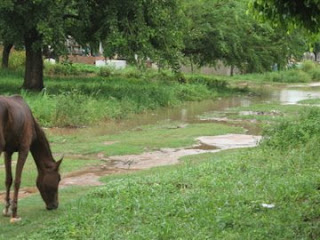 a little look at the rainy season, the road outside of our house
 our mango tree, some basil and LOTS of weeds
 Luna, all grown up
 our new dog princesa, for a princess, she's not all that fotogenic, but she has plenty of other princess like qualities:)
 Luna in her favorite sleeping spot, on the other side of the window is where we sleep, so you can see how it's prime real estate for a protective dog
 a little look at the rainy season, the road outside of our house
 our mango tree, some basil and LOTS of weeds
 Luna, all grown up
salteñas


Just as I had the idea of sharing with you one of the sweetest things 20 cents can buy in Santa Cruz, I got an email from my sister and my niece who are looking for more pictures of our house and dogs, and less of food. So, in the interests of pleasing all parties, I will include a few photos here that are not part of today’s blog theme: a little thing folks here like to call salteñas.
Salteñas, I believe are something unique to Bolivia. They are a cute little meat pocket made with a beautiful color of dough, full of potatoes, peas, meat and broth. Each reigon has their own style of making them. Santa Cruz salteñas are especially juicy and full. MCC likes to initiate new volunteers by serving salteñas the first day you arrive. There is a serious trick to eating Santa Cruz salteñas without getting the juice all over you, which involves carefully biting off the tip and draining out as much juice as possible through the tiny hole. After we eat salteñas at MCC, you can sure tell a difference (as if you couldn’t already) between a native cruzeno pro and a novice by the little stains we sport for the rest of the day.
In Chris and I’s neighborhood, we have a woman who at just about 7:45 every morning passes by our house offering salteñas. Luckily, I believe hers are more of a style of Potosi (a city about 24 hrs. west of here); much dryer. There is a tiny bit of gravy you need to be careful with at the very bottom, but it’s quite manageable. They are smaller than the ones you buy in the center of town, but at 25 cents a piece, (the ones downtown are about 75 cents) they are more affordable as well…which means we find ourselves getting them about 3 or 4 mornings per week.
martes, 22 de enero de 2008
Housing

I went to see my friend Doña Beti (doña (pronounced don-ya) is the name that goes before every woman’s name to show respect) about making me a cake for my buddy’s birthday. (she is pictured here on the far right side).But here in Bolivia, just like in many fine countries in the world, conversation kind of wanders around what you came for, and you tend to go to it for awhile and then talk about other stuff, then come back (often at the gringos promptingJ). Anyway, in the midst of the meandering, it came up that Dona Beti is moving. Which is a sad thing, because she’s one of the crucial social hubs in the barrio and she keeps things moving, and even though she’s only moving about six blocks away, it will really change things. I asked her why and she said she’s been renting this place and has found another place to live “casero” (which means the shack or whatever is on the property is not suitable enough to actually charge rent, so you make an agreement with the owner to take care of the property, usually for one year at a time for no cost).
She then talked about looking into buying a lot here, and she said there are some in the next neighborhood over (which is less developed than ours and has more open spaces) for $3500. At first I thought she was talking about bolivianos (which would still be $500 or so), but she actually meant dollars. She said they would probably give it to her on credit. She said her friend bought one awhile back for $100. With the arrival of several thousands of people to Santa Cruz each year, housing prices have sky-rocketed. My friend whose grandparents live just off the first ring in the center of the city told me their house is worth $100,000. I’m sure her grandparents settled there when there was nothing but forest beyond the first ring and probably everything including the construction of the house cost less than $100. In the 1960s when MCC was setting up its office, everyone told them they were out in the middle of nowhere and that people would never be able to find it (just between the 1st and 2nd ring). Now, their property is right smack in the middle of it all (and with five buildings on it and a nice piece of yard in the middle, I’m sure it’s worth several hundred thousand dollars now)..
Of course this means good things for people like Loida’s grandparents and MCC and other visionary folks who were able to buy up early and could cash out now. But for Doña Beti, who has lived and worked in this neighborhood for the past twenty years, the dream of owning her own place is just slipping out of grasp. The really crazy thing for me to think about is that during the three years that Chris and I are here in Bolivia, I’ve calculated that all the money we have saved and smartly (with the advice of my brother-in-law/financial advisor) invested will make us about half of what it costs to buy one of those lots. We get paid just for being rich. My first reaction to that is the easiest “well, could we give her all we’re going to make on the interest.” Which would leave us still rich, having dona beti still paying a lifetime of payments on her place, a whole neighborhood in line for another one of our generous donations and a system that still makes rich richer and poor poorer. We have got to think of something better. Any ideas?
Suscribirse a:
Entradas (Atom)