martes, 10 de febrero de 2009

End of the Year highlights

I know I'm about four months behind on blogging, so here are some images from the end of last year.

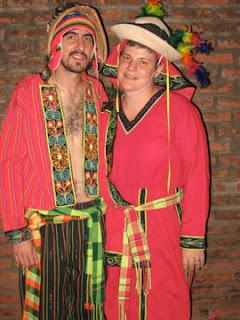
.there was a dance contest at 12:30 on a very hot day at the Parish anniversary party. My partner was persistent though, and we actually ended up winning.
This is one of my favorites. Alvaro's Graduation. He is one of 10 chidren (in the middle somewhere) and we were asked to be his padrinos of photography at his graduation.

THis is one of my favorite people in Bolivia. Her name is Benedicta. She is amazing. She works with the chapel and has a very beautiful inner strength. She washes our clothes for us (since we can't' seem to fathom spending half a day per week washing them ourselves) and she stays at our house and feeds our dogs whenever we're gone.
This one was taken at our friend Zulma's wedding, when I worked despartely to learn the wedding march in 3 days on violin. This is my first backless Christmas dress by the way.

martes, 4 de noviembre de 2008

The Dead Souls Arrive

This was a headline on the Saturday noon news. The day of the dead (November 2nd) has brought a great festival to all the cemeteries of Santa Cruz this weekend. Some, like my friends Irene and Idonlina, have traveled to their home towns to velar (to accompany) their loved ones who have passed on.
According to the teacher who teaches the sewing classes at our house, it’s also a dangerous time of the year, because people tend to die around that time. Last week she had the flu and she said her mom got especially worried and began lighting candles and praying for her.
There must be some kind of truth to this theory. On Sunday morning (the day of the dead) 4 people were buried in the cemetery beside our house, among them a neighbor of ours. I never actually met the woman, she was 93 and apparently never came out of her room. Both her daughter and her granddaughter participate in the sewing class, so we participated in the mass and the burial. This being the second time I’ve participated in a burial, I know that like many things in Bolivia, it involves sitting and waiting. As I sit I think about that moment when life as I know it will be no more, or even harder, of the time I may very well have to live whenever my own mama dies or my husband, or my friends, that space in time when your insides ache with memories.
On Sunday I took a stroll through our cemetery and found a hundred or so families, united. Depending where they come from, some have simple rice bread or empanadas, while others have huge spreads of doll-shaped breads, fruits or dishes of home-cooked meals. Some families had a quiet stillness about them. Only a few, like the 4 families whose loved ones so recently passed away, were actually crying.
I stopped by to chat with a friend, whose sister immediately put a glass of chicha (a traditional corn drink) and an empanada in my hand. “Oh yeah, he told me, “you just missed the band, it came over and we were dancing for awhile”. I looked over and sure enough there was a five-piece brass band making its way through the crowds of people. This same type of band often accompanies a funeral procession here.
This day is something I admire so much about this culture. When in North America do we ever take time away from our routines to think about those we have lost? We have one week of mourning (if that) and then all the rest of the grieving process is an individual one. I long for a space like this one to tend to those memories of people who have moved on from this world; a place to cry, a place to dance, a place to eat, and a place to share with others.

martes, 21 de octubre de 2008

Sacrament and Sacrifice


We spent the last week preparing for the big anniversary party at the parish where we work. As I’ve mentioned before, birthdays are a very big deal here, and anniversaries are really just like birthdays, since they are birthdays of groups and beloved places. Our biggest participation included a traditional dance with the confirmation class. During many festivities here, groups of young people (and occasionally older people) get together and choose from a WIDE variety of traditional dances of Bolivia. Last year, we danced a “carnivalito” with our youth group (a bouncy dance from the eastern lowlands). This year the group was convinced it wanted to dance Tinku, a fascinating dance derived from a fighting ritual in the department of Potosi. This ritual takes place during different festivals, but especially over the 3rd and 4th of May, the celebration of the holy cross. While some say it was once a way of settling debts between tribes so as to prevent all-out war, the main idea is to spill blood as a sacrifice so that there may be a good harvest.
Because dancing is a requirement in every public school in Bolivia (yearly festivals are held in the schools where classes are graded on the dance they present), almost everyone has some knowledge of how the dance should go. Because of this, there are very specific steps that have developed and depending on the song in the genre, the choreography is different. For example, someone brought a CD with 15 Tinku songs, and as each song would begin, the women would begin dancing what they remembered seeing of that song. Unfortunately for us, everyone remembered about one quarter of the steps to each one. Much time was spent correcting each other and speculating what should go in the blanks. After 6 practices of such interactions, the last night before the dance, one of the boys brought two friends who were experts in Tinku. They divided us up between men and women, we worked for two hours (this dance is INCREDIBLY strenuous…I have thoughts of opening up a tinku studio someday…it could be a great weight-reducing system) and at the end, we had it together. The following day we met up (an hour later than we had said) on “balivian” street, which is known to everyone in santa cruz as the place to go to rent costumes. Having been given specific instructions by the expert, Raul, we went from shop to shop asking “do you have 8 costumes in fuchsia?” “will you give us at least 3 feathers for our hats?” “will you give us two sashes instead of just one?” “ do you have pants to fit a 6ft tall gringo?” After about a half hour of searching, we found our place. For about $3 USD each we were ready to go.
The night of the party was full of enthusiastic young people, all dressed up, practicing some last minute moves. Our dance went well, and at that last minute someone showed up with a fire-work like apparatus that emitted orange smoke. Unfortuntely, they set it off right under my feet which made breathing a bit of a challenge, but in the end the crowd LOVED the performance, which somehow made all the preparation worth it.
Stepping back from it, I find myself becoming introspective. What a strange way of celebrating church, with sequins, ribbons, smoke bombs and dances representing sacrifices made to mother earth. It’s definitely a stretch from my early Christian years in a little old country church in PA. But as I sat in mass and watched as small children came dancing in with bright green and white dresses and straw hats, the beautiful thing is that people are offering who they are to God…all that they are. So often in the evangelical church, members are encouraged to leave behind all that is culturally relavant to them, to take up the plain black suit, the white dress, and follow Jesus (well, Jesus’ North American Missionaries anyway). My life here is composed of such moments of walking (and dancing) beside Bolivians and then stepping back, trying to figure out which lens to look through, how to toss these questions around and to act in a way that my life is a more perfect offering…
There are a lot more fascinating things to learn about Tinku. The following are two you-tube clips. The first is a report on the actual ritual in Potosi and the second is of the dance (it’s not quite as good as we were, but it’ll do☺).
http://es.youtube.com/watch?v=sTSTojpCZhs
http://es.youtube.com/watch?v=kesJ3BM-TLM

jueves, 2 de octubre de 2008

A rainy day


this photo is of the closing party for a sewing class we hosted in our house that I was going to write about (as well as the new priest (top right hand corner) I´m excited to begin working with, but I¨ve been inspired by something more urgent.

I¨ve been doing some thinking lately about what it is that could sum up the Bolivian experience....in a country where 32 different languages are spoken and the Andes Mountains cut through the landscape...creating historical cultural differences..what is there that unites everyone. For me, it´s come down to something very simple.

Every day in Bolivia is so very fragile.

I´ve lived here almost two years now, and in a way I feel like I´ve taken about 10 years worth of risks I would´ve taken had I been in the U.S. Which is funny, because I am someone whose housing is payed for...who has a consistent food budget every month, who gets $75 on top of that to spend on whatever I want...so I am still not taking anywhere near the risks of my neighbors who face questions like, ´will I be able to get to work?¨¨Will I get fired if I show up late?¨¨Even if I arrive on time and leave on time, will they decide not to pay me anyway?¨¨Will the price of bread have risen again?¨ And many other questions that make up a daily fight to survive. The one thing that I can perceive that Bolivians have going for them in all of this is that everyone else around them (except for two north american volunteers and a few brasilian nuns)is balanced on the edge of this same abyss.
This morning, I have found a perfect example to illustrate this point. It is pouring down rain. We are waiting a twenty mintues for a micro along with six other people. One shows up with space for maybe two...we all manage to squeeze on. Three blocks later, a young kid with a rake (???) jumps off and another six grown people manage to make thier way on to the bus. Just as we arrive at a HUGE lake that once was a paved street, we stop to pick up a crowd of two mothers with babies and an elderly woman, short, round, and covered in plastic bags. I exchange a worried glance with the woman whose head is resting in my armpit, ¨no deberían subir¨she whispered (they shouldn´t even try it)...the two moms make it on..the elderly woman puts her hands out to take hold of the door. Everyone in the micro takes a deep breath. Even if she can manage to grab ahold of something on the bus, with one quick turn she could fall out. The bus driver begins to move on.
¨NOOO POR FAVOR!!¨ The woman screams...she then begins wailing in quechua..and the bus stops again. Now, my experience here tells me there are potentially two situations that could warrant such desparate behavior. 1. This woman is having a medical emergency and needs to get to the hospital. or 2. It is her co-madre´s birthday and they are out of coca-cola at her corner store. Whatever the woman´s situation, she begins to try to pull herself up onto the first step. All of the sudden, a woman points to chris and says, ¨you there, move further back...the old lady needs to get on¨. We all shuffle around, a few onlookers on the street give the woman a boost and a young girl of about ten years old gets behind her to protect her from the threat of falling out. We turn the corner and begin our cruise through the river. About five minutes later, I look to the front to find a crowd of young people...someone has given the woman thier very-valuable seat (if you are sitting down, not only are you safe from the risk of someone resting thier head in your armpit, you are safe from people sticking thier hands in your pocket and stealing your wallet or your cellphone).
It took us a record-long time to get to the office this morning...an hour and a half from door step to door step (instead of the normal 45 minutes)...but oh what a story to share with all of you.

jueves, 25 de septiembre de 2008

Santa Cruz Flair and Hand Spun Wool


The other day in my crocheting class, our chatter turned for a moment to the political situation in Bolivia, sparked by the sounds of firecrackers getting closer and closer. “The Masistas are gathering, they have a cabildo tonight (town meeting)…they must be figuring out what to destroy next.” I’m usually very quiet during these times, but today for some odd reason (maybe my anger at how much the news manipulates the story according to its political leaning), I decided to offer my opinion, “but why would the masistas wreck their own market,” I said, “it’s got to be the cruzenistas…I think they want the military to come in so they have an excuse to have an armed conflict.” My friend (who’s from a small town near the boarder of Brasil) looked at me and said, “look at me…do you think I want a war???” (identifying herself among the cruzenistas….) another woman (who came to Santa Cruz from the Beni, a department just north of santa cruz) spoke “the highlanders should be thankful for what Santa Cruz has given them…a place to live and earn a living….” The teacher piped up, “well, I don’t think it’s that simple, for example I’m from Sucre but I’ve lived in Santa Cruz ten years…I don’t consider myself colla or camba (highlander or lowlander), and there are people from Santa Cruz living in Sucre. I think we’re all just a mix but the media tries to divide us more than we are in real life.” A woman responded, “yes, but when we go to other places, we don’t act like this….” Meanwhile, everyone was working away at their crocheting project, this week a hair tie made with a glitzy synthetic string imported from Brasil, except for me…I’d forgotten to bring elastic, so I took advantage of the fact that there’s a woman who knows how to spin wool…I bought some in Cochabamba last year, but when I tried to knit with it, it was lacking one more process to be knittable. This woman (a highlander) was the only one who hasn’t spoken by now….and as the yarn slips so smoothly between her fingers I asked her, “did you grow up with sheep?” And she answered in a very quiet voice, “yes, my mother had sheep.” As the conversation drifted on to the big Miss pageant coming up, I realized the tension of the country and how its imbedded in each person and the fear of the other…of who will throw the first stone…
Towards the end of the meeting, my friend from valle grande (western santa cruz) commented, “wow, Lindsey, you learned the trick!” I said, “yeah, it’s really easy, do you want to try it??” She looked at me smiling and told me no…that she wouldn’t want to mess it up.
I know that tonight Santa Cruz is full of these interactions…highlanders and lowlanders together..full of opportunity to be open to the other, or to continue with the rage provoked by images on the news (showing the same clip from three days ago).
A note for those who haven´t read much about Bolivia in the last few weeks, there is a good bit of conflict going on which I am trying to wrap my head around and am not quite confident enough to write about. If you´d like to read more on it though, here are two places I like to go:
www.democracyctr.org
www.ain-bolivia.org

lunes, 8 de septiembre de 2008

Padrinos Americanos

The other day I was at my friends house making saltenas when her younger sister came rushing in and said, " oh, I have to get my letter written today." I assumed she was talking about doing some kind of transaction with the government, applying for a birth certificate, getting a vaccine card etc. But when she sat down to write it, she pulled out a picture of an elderly north american couple. Ah yes, I thought, it's a letter to her "padrinos americanos" (american godparents). We as northamericans understand this system under a different title. " For only 30 cents a day you too can make a difference in a young child's life...sponser a child today." All my life I grew up watching these comercals with images of young kids with swollen bellies being attended by white doctors...and now I am so blessed to see things from the other side....among struggling families fighting to stay alive and live with dignity...looking to the north from where this charity comes.
One day I was part of a conversation where two women were talking about the different benefits offered between two different padrino organizations....one only gives medical care and tutor help with homework, whereas the other one gives periodic food donations to the families. And at one point in the conversation one of them turned to me and said curiously, "why do north americans want to be godparents to our children...don't they have enough children of their own to help?" I was caught in a rather difficult place. How do you describe a land where people have enough money to take care of their families plus enough to give away to someone you don't know...a place where all your neighbors also have thier needs met and don't have to come and ask you to borrow money or food...a place where charity is a concept of having to look in far far away places to look for suffering. Such a thing doesn't exist here in Bolivia, and so I did my best to explain the good intentions of people with extra money and a conscious mind.
In the meantime, daniela's sister writes under the shade of the mango tree, about her school work, about her second child on the way, about the springtime (which in santa cruz means very hot and windy wheather), and she includes a picture of a "traditional" santa cruz scene, a man in a straw hat working in a field of sugar cane. And I am breathing into the gap of two very different worlds.

sábado, 19 de julio de 2008

Tortilla Flat


John Steinbeck is one of my favorite authors (East of Eden is in the running for my favorite book of all time). Naturally, I was delighted to find in the MCC library a book by him that I had not yet read called Tortilla Flat. The book is a delightful tail of Mexican/Spanish/American vagabonds who live on the outskirts of the town of Monterrey California. Each chapter is almost like a short story in of itself where the 4 main characters scavange, cheat and steal and sit around making up virtuous justifications for such actions. All the characters are quite loveable which allows the reader to really identify with them, and personally had me thinking thoughts of how free they were to own virtually nothing and even more biblical thoughts like not storing treasures on earth, just worrying about today etc.
The very ironic thing is that on Friday we traveled to Montero to meet with “women without limits” (see second blog entry) and on our way home, stopped to get something to eat. It was a very normally chaotic scene as we sat down, including a man who dropped his change and was scrambling under our table to pick it up. We helped him gather his change only to find a minute later that my bag was missing. He was, like my lovable friends in tortilla flat, a robber, working to distract us while another person ever so carefully slid my bag out from the bench where it was placed beside me.
The good news is, ever since Chris got pick-pocketed on the bus a year ago, I no longer keep any money in any of the bags I carry. The bad news is, Tortilla Flat and the 30 pages I still had to read in it WERE in the bag. Here the only access we have to good old US classics are the MCC library, so they all take on a whole new value for us. A value which doesn’t translate to anyone who doesn’t read in English. So I suppose I could’ve searched the city’s garbage cans; or perhaps it lit someone’s fire that night for cooking…
It’s interesting to me the emotions one experiences when something is stolen. No matter what gets lost, you feel angry, violated, vengeful and maybe just a little bit stupid (had I only REALIZED he was trying to trick us!!!) But what stays with me is the question of what causes people to steal. I’m convinced it’s not simply laziness or the lack of initiative of finding an honest job. I see young people in Bolivia growing up in a place without hope. They watch their parents work 12 hour days 6 days a week, and it only earns them enough, in some cases, to stay alive. They might buy a piece of land, build a house or even buy a car taking out a loan, but all is very easily lost if that person gets sick or has an accient. There isn’t a whole lot of work that keeps one very motivated to be honest. Especially whenever you see friends or family members getting rich quickly by doing easier, more illegal things. All this leaves me with the determination to continue working with young people (frustrating as it may be) as well as a very lame satisfaction that I had no money in my bag. And it leaves the robbers with some bad luck (I’m sure they thought they’d get a lot from the gringa) and with the perpetual challenge of making a living in Bolivia.